From Goldfields to Country Town
There’s something rather special about Kilkivan.
Today it’s a quiet country town surrounded by grazing properties, farms and bushland. But look a little deeper and you discover a fascinating past — one shaped by gold, changing town sites, railway lines, hotels, Chinese market gardeners and plenty of people chasing their fortune.
And interestingly, the Kilkivan we know today isn't quite where the earliest settlement began.
So, let's take a little trip back in time...
Before there was a town
European settlement in the Kilkivan district began in the 1840s, when pastoralists were moving north in search of new grazing country.
One of them was John Daniel MacTaggart, who established the Kilkivan pastoral run. The name Kilkivan came from his Scottish connection and, long before there was a town, it was the name of the pastoral property.
Then came gold.
Gold changes everything
Gold was first discovered near Kilkivan in 1852, but there was no immediate rush. Local history records that MacTaggart concealed the assay details, so the news didn't spark the expected excitement.
That all changed in 1868 when gold was discovered at West Coast Creek.
Prospectors began arriving and West Coast Creek became the site of the first Kilkivan township. What had been a quiet pastoral district was suddenly a busy goldfield.
And people came from all over.
Among them were Chinese prospectors, some of whom mined for gold while others established market gardens to supply the growing population.
Rise & Shine
As gold mining continued, another important discovery was made.
The Rise & Shine gold reef, discovered in the early 1870s, was at the eastern end of what is now Bligh Street, near the Rifle Range. A settlement developed around the goldfield, complete with businesses and a hotel.
The Rise & Shine Hotel was established in this area in the late 1870s, giving us a wonderful glimpse into just how active this part of Kilkivan once was.
The local school also began here. Rise and Shine Provisional School opened in 1876, before the settlement went through further changes of name, including a period when it was known as Neureum, before the name Kilkivan was restored.
The exact sequence of those early place names isn't completely consistent across historical sources, but what we do know is that Rise & Shine was an important part of the early Kilkivan story.
The town moves
Here's one of my favourite parts of Kilkivan's history.
The town moved.
When the railway arrived in 1886, the focus of the community shifted towards the railway station, around the area of today's Crescent Street and Kilkivan Bowls Club.
The railway opened up new opportunities for transporting people, goods and produce and changed the way the town functioned.
Then, in 1902, the railway was extended to Goomeri, and historical records indicate that the old town site came back into favour.
So Kilkivan's history isn't a straight line. The community grew, shifted and adapted as circumstances changed.
Buildings could move too!
And here's another wonderful piece of Kilkivan history.
The Railway Hotel was actually moved to Kilkivan from Mount Coora, about 10 kilometres south.
Francis Nicholas Davey purchased the two-storey hotel, had it moved to Kilkivan and converted it to a single-storey building. It was then positioned close to the railway terminus.
I love this little piece of history because it shows just how practical people were in those days.
If a building could be moved, apparently... move it!
And then there was the gold...
One of the famous discoveries on the Kilkivan goldfield was a 73-ounce gold nugget — weighing just over two kilograms.
Imagine finding that!
But, as happened with so many goldfields, the easy gold eventually became harder to find. By the early 1900s, Kilkivan was gradually developing a new identity.
Gold was giving way to farming, grazing and timber.
In 1911, Kilkivan Station was resumed by the Queensland Government and divided into smaller holdings, helping shape the rural landscape around the town.
Kilkivan today
Today, Kilkivan is a very different place from the bustling goldfield of the 1860s and 1870s.
But traces of those early days are still here — in the old buildings, roads, railway history, family stories and the landscape itself.
The Kilkivan & District Historical Museum, at 12 Bligh Street, holds a wonderful collection of photographs, documents and objects telling the story of the district.
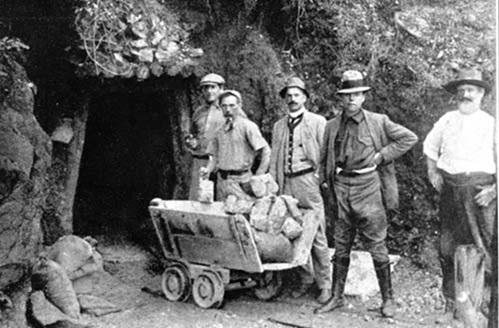
And one of the treasures in the Gympie Library Photo Collection is a genuine historical photograph titled “Gold Mining near Kilkivan, ca. 1914.”
Looking at an image like that more than a century later makes the history feel very real.
These weren't just names in an old book.
They were people who came here looking for gold, built homes and businesses, opened hotels and stores, raised families and eventually adapted as Kilkivan changed from a goldfield into the country community we know today.
And perhaps that's what makes Kilkivan so special...
Kilkivan isn't simply a country town with an interesting history.
It is a town that changed and adapted.
It began with a pastoral run.
Gold brought people rushing in.
The settlement developed around the goldfields.
The railway arrived and shifted the focus of the community.
Gold eventually gave way to farming, grazing and timber.
And through it all, Kilkivan remained.
Today, when you drive through town, it can be easy to see only the quiet country community that exists now.
But underneath it is a much bigger story — one of gold miners, graziers, shopkeepers, publicans, railway workers and families who helped shape the Kilkivan we know today.
And perhaps that's the beauty of living in a place like Kilkivan.
Every old building, every road and every paddock has a story.
You just have to stop for a moment and look for it.
A little note from Karen
As someone who works with property throughout the Gympie and Fraser Coast regions, I love discovering the stories behind the places I work in.
Kilkivan has such a fascinating history, and the more I learn about it, the more I appreciate the character of this wonderful little country town.
Local knowledge isn't just knowing the roads and the properties.
Sometimes, it's knowing what happened here 100, 150 or even 170 years ago. ❤️
A note about the history
This article has been compiled from a range of local historical sources, including the Kilkivan & District Historical Museum, Gympie Regional Libraries, Gympie Regional Council’s heritage records and the publication Where Two Rivers Run: A History of Kilkivan Shire by David Logan (1988). Additional information was drawn from the Gympie Regional Memories collection, which features historical photographs, documents and research relating to the Kilkivan district.
The Kilkivan & District Historical Museum at 12 Bligh Street holds more than 22,000 items of local significance, including photographs and documents relating to mining, forestry, dairying, and the town, school and family histories of the district. Gympie Regional Council
Historical accounts of Kilkivan's early years sometimes differ in the exact sequence of events and place names. Where this occurs, the article has used the most consistently supported information and avoided presenting uncertain details as fact.
Photo: Gold Mining near Kilkivan, ca. 1914 — Gympie Library Photo Collection.
Sources
Kilkivan & District Historical Museum — local history, photographs, documents and museum records.
Gympie Regional Libraries / Gympie Regional Memories — historical photographs and local-history research, including History of Kilkivan Township, Kilkivan Mining History and Kilkivan Hotels. Gympie Regional Memories
Logan, David (1988), Where Two Rivers Run: A History of Kilkivan Shire — Kilkivan Shire Council.
Kilkivan Historical Society (2008), Kilkivan Historical Town Walk — Kilkivan & District Museum.
Gympie Regional Council Heritage Places Study — historical information relating to the development and movement of the Kilkivan township and railway.