Miva might be quiet today, but this little Mary River community has a history far bigger than its size suggests.
There are places that announce themselves, and then there are places like Miva.
Tucked beside the Mary River in the Gympie region, Miva is easy to drive through without realising just how much history is sitting quietly around you.
Today, Miva is a peaceful rural community surrounded by farms, bushland and the river. But more than a century ago, it was a busy little rural district where families farmed, timber was milled, trains carried livestock and produce, and local businesses and community organisations helped keep the district connected.
At the heart of it all was the Mary River.
Where did the name Miva come from?
The name Miva dates back to the pastoral era of Queensland.
Queensland place-name records trace the name to a pastoral run associated with Gideon Scott in March 1851. The name is believed to be Aboriginal in origin, although the particular language or dialect has not been identified. Historical interpretations have suggested meanings including “stony knob” and “Moreton Bay chestnut”.
Whatever its exact meaning, the name Miva has been part of this district for more than 170 years.
The early days
By the 1870s, families were already farming and living around Miva.
The Mary River was both an asset and an obstacle. It provided water and fertile country, but it also had to be crossed.
By 1870, a punt was operating at Miva, providing a way for people and goods to cross the river.
And the river could be unforgiving.
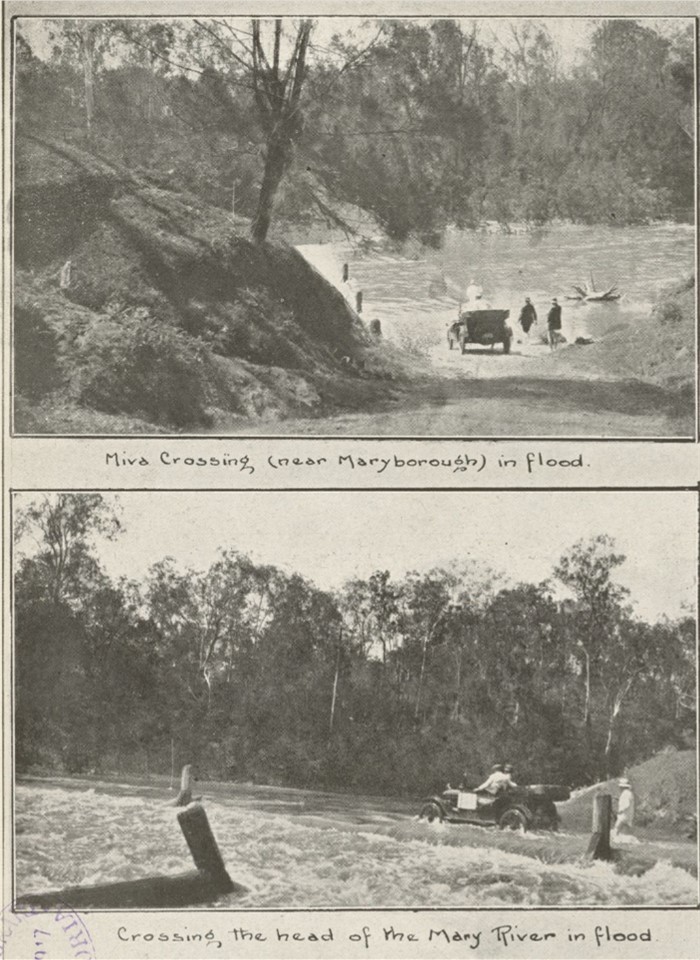
One of the most striking historical images of Miva is a photograph taken by G. W. Whatmore in 1917, showing Miva Crossing during a flood. Published in The Queenslander Pictorial Supplement on 17 November 1917, the photograph records floodwater approximately two feet deep across the crossing.
It provides a fascinating glimpse into everyday life in Miva more than a century ago — and a reminder that living beside the Mary River has always meant learning to live with its floods.
Hero photograph: Miva Crossing in flood, 1917. Photograph by G. W. Whatmore, published in The Queenslander Pictorial Supplement, 17 November 1917.
The railway changes everything
The arrival of the railway in the 1880s brought another major change.
The railway reached the Kilkivan district in December 1886, and Miva became part of this important transport network. The railway connected local farms and industries with wider markets and provided a much easier way to move people, livestock, timber and produce.
Miva was no longer simply a collection of farms beside the river.
It was becoming an important rural centre for the surrounding district.
Historical railway records show Miva handling agricultural produce, livestock and timber, reflecting the productivity of the surrounding farming and timber country.
Farming, dairying and timber
Farming was the foundation of life in Miva, with cattle, pigs, crops and dairying all contributing to the local economy.
Timber was another important industry.
Several sawmills operated in the Miva district over the years, including the Miva Sawmill Company from 1923 to 1926, T. R. Rayner from 1941 to 1942, and Fairlie & Sons Pty Ltd from 1947 to 1959.
The timber industry provided employment and connected Miva with the wider region. By 1959, the Fairlie mill was being electrified as electricity arrived in the community.
The district even gave its name to a local timber — Miva mahogany.
The heart of the township – Nahrung's General Store
One of the best examples of Miva's growth is the story of Nahrung's General Store.
William Nahrung opened the store on 1 November 1900, initially operating from a room off the kitchen of his home.
By 1905 he had built a small shop, and as trade increased the premises were expanded. In 1919, a further extension was made and a shed was built for produce and other heavy goods.
Then, in 1926, Alex Nahrung built a much larger shop facing the railway line.
Known as “The Bigger Value Store”, it carried a wide range of goods and became an important part of everyday life in Miva. As motor vehicles became more common, petrol bowsers were installed, and a later shed was used for heavy hardware and drums of petrol.
Historical records even preserve some of the prices from the store in 1916 — giving us a fascinating glimpse into everyday life more than 100 years ago.
It is easy to imagine the store as a place where people came not only to buy what they needed, but to catch up on local news, meet neighbours and keep up with what was happening around the district.
A surprisingly busy little community
For a small rural settlement, Miva had an impressive range of services.
There was the general store, railway station, post office, butcher, garage, sawmill and hotel, along with the school and a number of community organisations.
The F. J. Bulmer garage was another important part of local life. Mr Bulmer was a skilled mechanic as well as the local cream carrier, and he also delivered meat, bread, groceries and mail to people living throughout the surrounding districts.
The post office had been operating as a receiving office from 1888, with the Miva Post Office established by 1908. It remained part of the community until 1976.
These businesses and services tell us something important about old Miva.
It wasn't simply a rural area dotted with farms.
It was a genuine little community centre for the surrounding district.
School days
Education was also an important part of Miva's story.
Miva Provisional School opened around 1888 and became Miva State School on 1 January 1909.
For a period, the school operated as a half-time school, sharing a teacher with Sexton. It closed in 1924, reopened in 1926 and eventually closed permanently around 1934.
For the families who lived in the district, the local school would have been much more than a place where children learnt their lessons. It was another place where neighbours met and community life unfolded.
The CWA and the community spirit
The Miva branch of the Queensland Country Women's Association was established in 1928, with Mrs G. W. Nahrung as its first president.
The CWA became an important part of community life, particularly during difficult times.
The building itself has a wonderful story.
The Miva CWA purchased the former Scotchy Pocket School building and had it moved to Miva in 1952. It opened as the Miva CWA Rest Room in 1953.
Over the years, the building served many purposes — including as a church, Sunday School, polling booth, meeting place, dance hall and pottery school.
And remarkably, the building is still standing today at the corner of Miva Road and Munna Creek Road.
That little building is more than an old community hall.
It is a surviving piece of Miva's story.
A community shaped by the river
Floods have always been part of life along the Mary River.
Miva's early crossing arrangements and the historic flood photographs all tell the same story: the river could provide opportunity, but it also demanded respect.
The famous Dickabram Bridge eventually became one of the district's most important landmarks and crossings.
But that is a story of its own — and one that deserves a blog of its own.
Miva today
Like many small rural communities, Miva has changed.
The railway is gone. The school has closed. The post office disappeared decades ago, and many of the businesses that once served the district are now memories preserved in photographs, documents and the stories of local families.
But Miva itself remains.
The Mary River is still there.
The farms are still there.
The old CWA building still stands.
And the names of families who helped shape the district remain woven through its history.
Historical publications such as A Century of Settlement in the Miva District, 1859–1959, compiled by the Miva QCWA, and Miva and the Nahrung Store by Colin Nahrung have helped preserve the stories of the people and businesses that made the community what it was.
A little town with a big story
Miva may be quiet today, but spend a little time looking into its past and another picture emerges.
You find farming families and timber workers.
You find trains carrying livestock and produce.
You find a general store that grew from a room beside a kitchen into a substantial country business.
You find a garage that delivered groceries and mail as well as fixing machinery.
You find children heading off to school, women building community through the CWA, and generations of families making a life beside the Mary River.
And you find a community that adapted, worked hard and looked after its own.
That is the story of Miva.
A little Mary River township with a history much bigger than its size.
And next time, we'll cross the river and tell the story of one of Queensland's most remarkable historic bridges — Dickabram Bridge.
Sources & further reading
Gympie Regional Libraries, Dickabram Bridge Centenary 1886–1986: A Brief History of the District
Miva QCWA, A Century of Settlement in the Miva District, 1859–1959
Colin Nahrung, Miva and the Nahrung Store, 1994
Queensland Government, Queensland Place Names records
State Library of Queensland, historical photographs and collections relating to Miva
Queensland Government, historical records relating to the Queensland timber industry
Miva Crossing in flood, 1917.
Photograph by G. W. Whatmore, published in The Queenslander Pictorial Supplement, 17 November 1917. Image courtesy of the State Library of Queensland.